
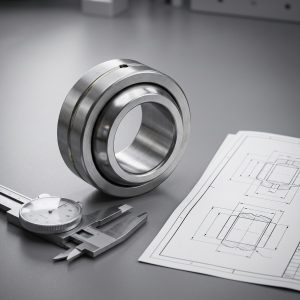
Many of the bushing part numbers on an equipment parts diagram are not special parts. They are standard spherical plain bearings or sleeve bushings that the machine builder put its own number on. If you can match the dimensions and the construction, you can usually buy the same part as a standard catalog item, without the dealer number and without the dealer markup. The catch is that “usually” is doing real work in that sentence, so this guide covers how to make the match and when not to trust it.
Why does an OEM bushing number have a standard equivalent?
Because the dimensions are standardized. Radial spherical plain bearings, the self-aligning type found in cylinder rod and tube ends, are dimensionally standardized by ISO 12240-1, which specifies dimension series, tolerances, and radial internal clearances. SKF states that its GE, GEH and GEG series conform to it, and other makers say the same. Sleeve bushings follow similar dimensional conventions.
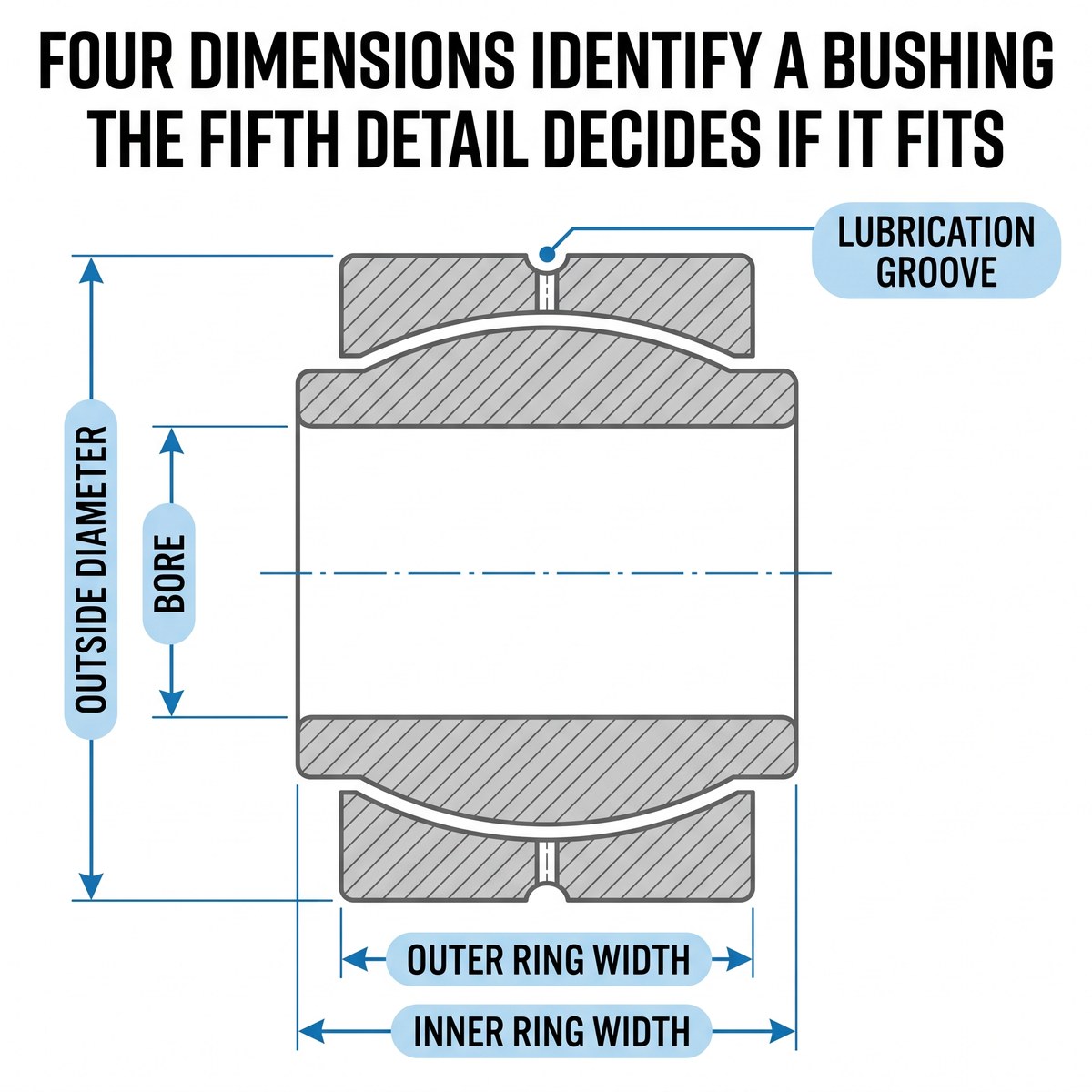
That means the dimensions come out of a published table, not out of the machine builder’s imagination. But bore alone does not identify the bearing. ISO 12240-1 defines several dimension series, and a 50 mm bore appears in more than one of them. In series E a 50 mm bore is 75 mm outside diameter with a 35 mm inner ring and a 28 mm outer ring. In series G the same bore is 90 mm outside diameter with 56 mm and 36 mm. You need all four dimensions before the number means anything.
What you do get is this: the machine builder did not design a unique bearing for that joint. It selected a catalog part, assigned an internal number, and printed that number in the parts book. You will sometimes find the standard designation printed right on a dealer’s own listing, in a field labeled something like “industry part number.” The information is not secret. It is just scattered.
How do you cross-reference an OEM bushing number?
- Start with the OEM number, not the description. Descriptions like “bushing, self aligning” match hundreds of parts. The OEM number is the only unambiguous starting point.
- Find the four dimensions that define the part. For a radial spherical plain bearing those are bore, outside diameter, inner ring width, and outer ring width. For a sleeve bushing it is inside diameter, outside diameter, and length.
- Match all four dimensions to a standard series. A bearing measuring 50 mm bore by 75 mm outside diameter, with a 35 mm inner ring and a 28 mm outer ring, is ISO 12240-1 dimension series E at a 50 mm bore, the envelope the bearing industry designates GE 50.
- Then match the construction, which is where most mistakes happen. Same envelope does not mean same bearing. Check whether the part is steel on steel or lined, sealed or open, grooved for relubrication or not.
- Confirm against the machine, not just the chart. If the joint has a grease fitting, the bearing has to have a lubrication path, meaning grooves and feed holes, or the fitting does nothing. If there is no fitting, do not assume a maintenance-free liner. Some steel joints are simply packed at assembly and serviced at rebuild. Check the parts book, or check the part you pulled out.
A worked example: John Deere AH150341
AH150341 is a John Deere self-aligning bushing that aftermarket suppliers list for the blade angle and tilt cylinder rod ends on 700-series crawler dozers, 700H through 700L. Dealer catalogs also show it on forestry carriers, so confirm the application against your own machine’s parts book rather than assuming. Published dealer specifications give it as:
| Specification | Value |
|---|---|
| Bore (inside diameter) | 50.00 mm |
| Outside diameter | 75.00 mm |
| Inner ring width | 35.00 mm |
| Outer ring width | 28.00 mm |
| Type | Grooved, self-aligning (steel on steel per the GE 50 ES designation) |
| Industry designation listed by the dealer | GE50ES/U |
The dealer lists it exactly as GE50ES/U. GE 50 ES is a real industry designation. The /U appears to be the dealer’s own tail and is not a suffix SKF, Schaeffler/INA or NTN publish, so treat it as a catalog artifact rather than a construction code.
Those four dimensions are ISO 12240-1 dimension series E, bore 50, straight off Table 1 of the standard. That envelope is what the bearing industry designates GE 50. The “GE 50” tells you the family and the bore. The suffix tells you the construction, and the suffix is the part worth slowing down for.
Note the word grooved. A lubrication groove and feed holes in the outer ring are what let grease reach the sliding surface on a joint that gets serviced. If the original part is grooved and the replacement is not, the joint cannot be relubricated through its fitting, and a steel on steel bearing that cannot be relubricated will wear out far faster than the joint was designed for. That single detail matters more than anything else in the table.
What do the suffixes on a GE number mean?
Suffixes are not universal. They are each manufacturer’s code, and the same envelope carries different letters from different makers. These are the common ones:
| Designation | Maker | Construction | Relubrication |
|---|---|---|---|
| GE…ES | SKF and most copies | Steel on steel, open, both rings hardened | Required |
| GE…ES-2RS | SKF and most copies | Steel on steel, seals both sides | Required, the seals hold grease in and dirt out |
| GE…-DO | INA / Schaeffler | Steel on steel, the INA equivalent of ES | Required |
| GE…-UK | INA / Schaeffler | Hard chromium on a bonded PTFE composite liner | Maintenance free, do not grease |
| GE…C, GE…TX | SKF | Steel on PTFE sintered bronze, steel on PTFE fabric | Maintenance free, must not be lubricated |
Before you buy on a suffix, check that suffix against the catalog of the maker whose part you are actually getting. A letter that means steel on steel in one system can mean something else in another.
Steel on steel bearings in this family have hardened sliding surfaces on both rings, manganese phosphated and treated with a molybdenum disulphide running-in lubricant at the factory. That running-in treatment is not lifetime lubrication. These parts are built to be greased on a schedule, and most sizes carry an annular groove and two lubrication holes in each ring so grease can reach the sliding surface. Our guide to lubrication for radial spherical plain bushings covers grease selection and intervals.
Getting this backwards is the expensive version of the mistake. A PTFE-lined bearing lubricates itself by transferring a film of PTFE onto the mating ring, and outside grease interferes with that film. The liner can also swell under grease, oil and moisture. The makers do not hedge on this, and their instruction is simply not to lubricate. Running a steel on steel bearing dry will destroy it, and often the pin with it.
When should you not trust a cross-reference?
Be careful in these cases:
- The dimensions match but the feature set does not. Seals, grooves, relube holes, and liner material all change the part while leaving the envelope identical.
- The published cross-reference came from an unverified source. AI answers and forum posts often trace back to a real spec table, but they also often do not. While writing this we found a retailer describing a steel on steel part as maintenance free, which is the opposite of what the manufacturer says. Treat any cross-reference as a lead to confirm, not a conclusion.
- The joint has been modified or previously repaired. A reworked housing or an oversize pin makes the parts book wrong regardless of the number.
- The application is structural or safety critical. Load ratings and tolerance class matter, and those are not visible in a four-dimension match.
The reliable way to close the gap is to measure the part you pulled out and confirm the dimensions and features against the replacement before it ships. A five-minute measurement is cheaper than a second teardown, and we have a step-by-step on how to measure a sleeve bushing for an exact replacement.
Frequently asked questions
Is an aftermarket bushing the same quality as the OEM part?
It depends on the supplier, not on the label. In plenty of cases the OEM part is a catalog bearing with a machine builder’s number on the box. In others it is not. What varies is the steel, the hardening, and the dimensional control. Buy on the specification and the supplier, not on whose logo is on the box. Our guide to steel bushing lead times covers how to tell a stocking supplier from a broker.
Can I measure a worn bushing to get the dimensions?
Yes, but which dimensions you can trust depends on which kind you have, and the two behave in opposite ways.
On a sleeve bushing, the bore is the sliding surface. It wears oversize, so a bore reading off a used part will be large. Take the bore from the parts book and size the replacement to the pin’s nominal diameter and the fit the joint calls for, not to a worn pin.
On a radial spherical plain bearing, the sliding surface is the spherical interface between the inner and outer rings, inside the bearing where a caliper cannot reach. The bore and the outside diameter are mounting fits, not sliding surfaces, so they normally survive wear and are the dimensions you can trust off a used part, along with both ring widths. What wear does to a spherical plain bearing is open up its radial internal clearance. You find that as play when you rock the rings against each other, not with a caliper.
So measure bore, outside diameter, inner ring width and outer ring width off the old bearing to identify the envelope, and judge whether it is worn out by how much play it has developed.
What if the OEM number crosses to nothing?
Then it is usually a dimension problem rather than a sourcing problem. Measure the part, and match on dimensions and construction instead of on the number. A part that appears to cross to nothing often turns out to be a standard size once it is measured.
Does a cross-reference void my warranty?
Not automatically, but be careful how hard you lean on federal law here. The Magnuson-Moss Warranty Act and the FTC rules under it, the ones that stop a manufacturer from conditioning warranty coverage on the use of its own branded parts, apply to consumer products, meaning property normally used for personal, family or household purposes. Commercial construction and forestry equipment generally falls outside that, and the FTC’s own rules specifically carve out farm machinery used in the business of farming.
On a machine like that, what governs is the written warranty you signed. Most do not void wholesale over a non-OEM part, but most do exclude damage the warrantor can show that part caused. Read the actual warranty language before you swap a part on a machine still under coverage, and if it is on an extended or dealer service plan, ask the dealer in writing.
Getting the right part
We have been supplying hardened steel bushings for more than 25 years, and we keep them in both inch and metric sizes on the shelf here in the United States, sleeve bushings and radial spherical plain bushings alike. We buy factory direct, so there is no distributor markup in the price, there is no minimum order, and stock orders usually ship the same day.
If you have an OEM number you are trying to cross, or a part in your hand and a caliper, call us at 860-693-1797. Give us the number or the dimensions and we will tell you what it is, whether we have it, and what it costs. If it is not something we stock, we will say so.
Manufacturer part numbers and descriptions on this page are given for reference only. They identify what a part fits. They do not imply that any part we sell is produced by that manufacturer.