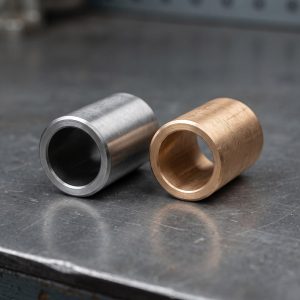
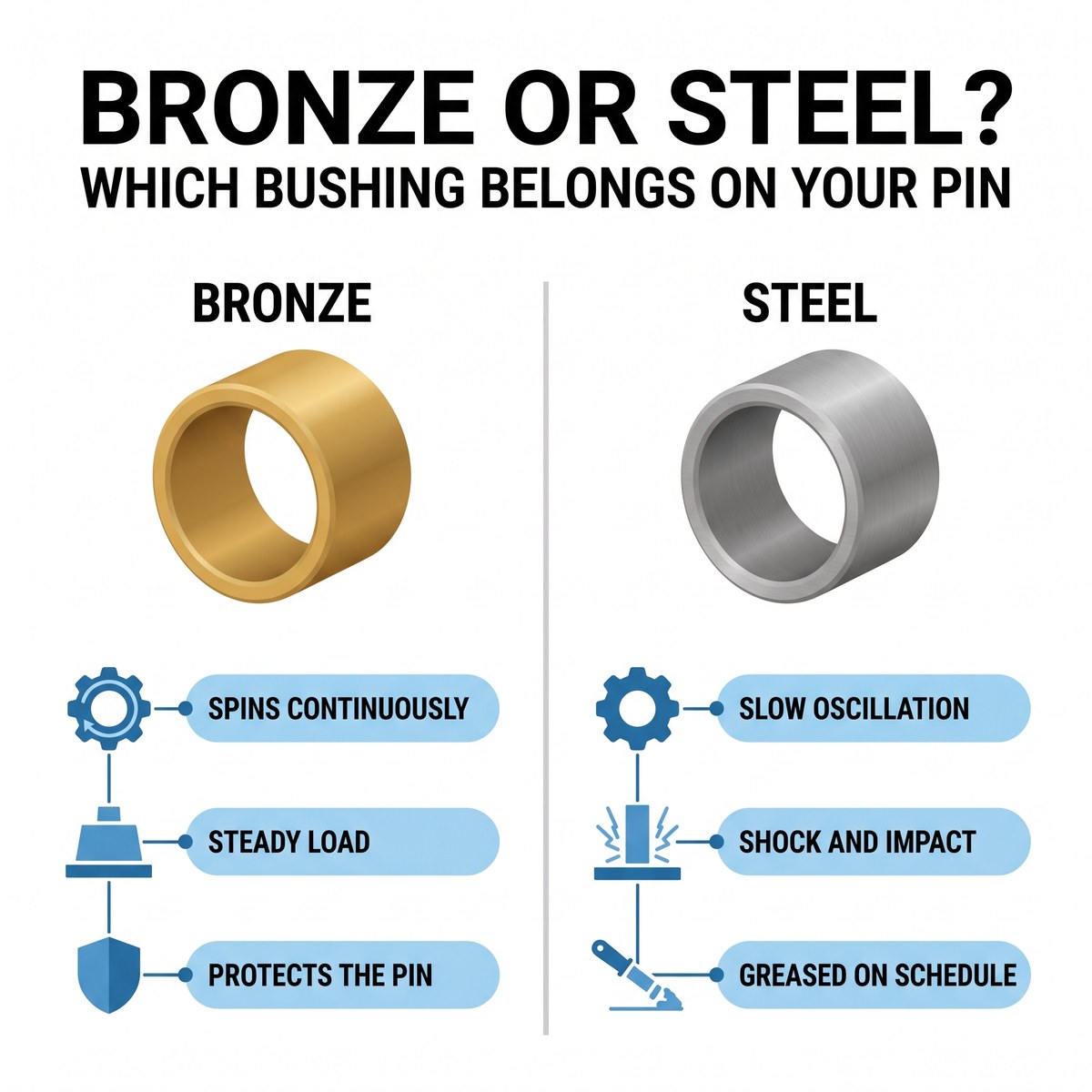
Bronze bushings are the better choice when a joint rotates continuously at moderate load and gets lubricated on a schedule. Hardened steel bushings are the better choice when the joint takes shock loads, carries high pressure over a small area, oscillates slowly through a few degrees, and lives in dirt. Most pin joints on construction, mining, logging, and agricultural equipment fall into that second group. That is why the factory usually put a hardened steel bushing in them, and why putting one back is usually the right move.
Here is how to tell which side of that line your joint is on.
What is the actual difference between a bronze bushing and a steel bushing?
It comes down to hardness, and everything else follows from it.
A typical cast bearing bronze bushing uses C93200, also called SAE 660. It is a leaded tin bronze, roughly 81 to 85 percent copper, 6.3 to 7.5 percent tin, 6 to 8 percent lead, and 2 to 4 percent zinc. The lead is not filler. It smears across the bearing surface under load and acts as a solid lubricant. C93200 runs about 65 Brinell hardness. Continuous cast material carries a 35,000 psi minimum tensile and 20,000 psi minimum yield; sand and centrifugal cast come in lower, at 30,000 and 14,000 psi.
A hardened steel sleeve bushing is a different animal. Case hardened and ground, the working surface typically comes in at HRC 58 to 62 over a tougher, lower-hardness core. Induction hardened bushings are common too and usually land somewhere around HRC 50 to 55, so expect roughly HRC 50 to 62 depending on the process. Put on the same scale, an HRC 58 to 62 surface converts to about 615 to 690 Brinell against the bronze’s 65. That is close to an order of magnitude.
So the trade is simple: bronze is soft and forgiving, steel is hard and unforgiving. Both of those are advantages in the right joint.
When is bronze the right call?
Reach for bronze when:
- The joint turns, rather than rocks. Continuous rotation at moderate speed lets a lubricant film build and stay built. Bronze is happiest there.
- Loads are steady, not impact. Bronze yields at a fraction of what a hardened steel bushing will take.
- The pin is the expensive part. Bronze is designed to be the sacrificial component. It wears so the shaft does not.
- Grit is present and you cannot regrease often. Bronze is soft enough that some hard particles bury themselves in the bore instead of circulating and scoring the pin.
- The bushing is oil impregnated or graphite plugged and there is no grease fitting anywhere on the joint.
- Corrosion is the enemy. In wet, salty, or chemical service, bronze holds up better than plain carbon steel.
When is hardened steel the right call?
Reach for hardened steel when:
- The joint takes shock. Bucket teeth hitting rock, a log grapple slamming shut, a plow catching a curb. Peak pressure at the top of the bore will permanently deform a bronze bushing long before it bothers a hardened one.
- The joint oscillates slowly through a small arc. Boom, stick, bucket, blade, and hitch joints do not spin. They sweep a few degrees under enormous load, so a full hydrodynamic film never develops and the joint runs in boundary and squeeze-film conditions. Surface hardness is what carries it, not the film.
- Unit pressure is high. A short bushing on a big pin has very little projected area, and all the load goes through it.
- You regrease on a schedule. Grease grooves and a grease hole in a steel bushing are there to flush abrasives out of the joint rather than embed them. That works only if grease is actually going in.
- Heat cycling matters. Bronze expands roughly half again as much as steel for the same temperature rise, about 10 versus 6.5 millionths of an inch per inch per degree F. It is a secondary effect, but a steel bushing in a steel housing moves with the housing, so the press fit and the running clearance stay closer to where you set them.
- You need it today. Common inch and metric hardened steel sleeve bushing sizes are stock items. An odd or oversize bronze ID is often a machining job.
Bronze vs steel bushings at a glance
| Bearing bronze (C93200 / SAE 660) | Hardened steel sleeve bushing | |
|---|---|---|
| Surface hardness | About 65 Brinell | HRC 50 to 62 depending on process, roughly 500 to 690 Brinell |
| Yield strength, minimum | 14,000 psi sand cast, 20,000 psi continuous cast | Far higher, hardened alloy steel |
| Motion it prefers | Continuous rotation | Slow oscillation under load |
| Shock and impact | Poor to fair | Good |
| Dirt handling | Embeds some abrasives rather than circulating them | Flushes grit out through grooves |
| Lubrication | Greased, oil impregnated, or graphite plugged | Greased on a schedule through a hole and grooves |
| Thermal movement in a steel housing | Expands more than the housing | Moves with the housing |
| Failure mode | Bushing wears out first, by design | Long life, but hard on a soft pin if run dry |
Can you just swap a bronze bushing for a steel one?
Physically, often yes. If the inside diameter, outside diameter, and length match and the press fit is right, a steel bushing will go where a bronze one came out. The question is what happens to the pin afterward.
Bronze is a sacrificial part. Steel is not. Put a hardened steel bushing against a soft or already worn pin and the pin becomes the wear item, which is usually the more expensive half of the joint. Two rules keep you out of trouble:
- If the OEM put a hardened steel bushing there, put a hardened steel bushing back. The pin was almost certainly hardened to match.
- If it came out bronze, ran for years, and there is no grease fitting on the joint, stay bronze. A plain hardened steel bushing with no lubrication path will gall.
The upgrade case that does make sense: the joint already has a grease zerk and a hardened pin, and the bronze bushing is simply not lasting because the loads are higher than the original design assumed. That happens constantly on machines fitted with bigger buckets, heavier attachments, or more aggressive hydraulics than they left the factory with.
How do you spec the replacement once you have picked a material?
Do not measure the old bushing and order from that. A worn bushing measures wrong. The housing bore and the pin are the truth.
- Measure the housing bore and the pin outside diameter with calipers or a bore gauge.
- Size the bushing outside diameter for an interference fit in the housing.
- Size the bushing inside diameter for a running clearance on the pin, remembering that pressing a bushing into interference closes its bore. Expect the ID to shrink by roughly 70 to 100 percent of the interference, so check it again after installation and ream if needed.
- Confirm inch or metric before you order. A 1 inch bore and a 25 mm bore are 0.016 inch apart, close enough to look identical and far enough apart to either seize or run sloppy.
- Note whether the original had a grease hole, a grease groove, or both, and match it.
Our guide to measuring a sleeve bushing for an exact replacement walks through the measurements in detail, and the steel sleeve bushing buyer’s guide covers fits and tolerances.
Frequently asked questions
Are steel bushings self lubricating?
No. A hardened steel sleeve bushing needs grease, which is what the grease hole and grooves are for. If the joint genuinely cannot be regreased, that is usually a sign you want a different type of bearing rather than a different sleeve. Our maintenance-free line is the PTFE lined spherical plain bushings, which run without grease by design. Call and tell us the joint and we will point you at the right one.
Will a steel bushing wear out my pin faster than bronze would?
Against a hardened pin, no. Against a soft or worn pin, yes. Replace the pin with the bushing whenever the pin shows measurable wear or scoring.
Is bronze better for corrosion resistance?
In wet, salty, or chemical service, bronze holds up better than plain carbon steel. For most dirt-and-rain construction and agricultural service a greased steel bushing does fine, because the grease is doing the protecting.
What hardness should a steel bushing be?
Case hardened bushings for pin joints are commonly ground to HRC 58 to 62 at the surface, over a tougher, lower-hardness core that absorbs shock and stops cracks from running. Induction hardened bushings are typically a bit softer. A through-hardened part at that hardness has far less impact toughness and is much more likely to crack in a joint that takes hits.
Can I put a bronze bushing in an excavator bucket pin joint?
It will fit, but it is the wrong material for that joint. Bucket and stick joints are slow oscillating, high load, high shock, and dirty, which is the exact profile hardened steel is built for.
Not sure which one you need?
Tell us the machine, the pin diameter, and what came out, and we will tell you what belongs back in. Ball Bushing Warehouse stocks hardened steel sleeve bushings in inch and metric sizes with no minimum order, and in-stock parts ship the same day from our US warehouse. We have been doing this for more than 25 years, factory direct, with no distributor markup in the middle.
Call 860-693-1797 or browse our steel sleeve bushings.