
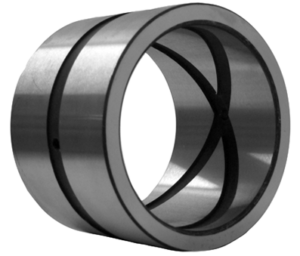
Bushings carry massive loads and allow for smooth rotation, but because they are often tucked away, they are “out of sight, out of mind”—until something goes wrong.
Running a bushing to the point of total failure doesn’t just mean a broken part; it often means a ruined shaft, a cracked housing, and thousands of dollars in unscheduled downtime.
Here are the critical signs of wear every technician should look for during an inspection.
1. Physical Play and Increased Tolerance
The most obvious sign of failure is “slop” in the joint.
- The Test: Use a pry bar to check for movement between the shaft and the housing.
- What it means: Even a few thousandths of an inch of extra clearance can cause a “hammering” effect every time the load shifts. If you can see the movement with the naked eye, the bushing is likely past its service life.
2. Abnormal Noise (Squeaking, Grinding, or Clunking)
If your equipment is “screaming,” it’s telling you the lubrication barrier has failed.
- Squeaking: Often indicates a dry bushing where the grease has been pushed out or the self-lubricating liner has worn through.
- Clunking: Usually indicates that the clearance is so high the shaft is physically striking the inner wall of the bushing.
3. Discolored or “Burnt” Grease
When you perform a routine grease service, pay close attention to what comes out of the purge.
- The Sign: If the grease looks black, gritty, or has a “burnt” metallic smell, it’s a sign of extreme friction.
- The Culprit: This is often caused by galling—where the metal surfaces are essentially welding themselves together and tearing apart during rotation.
4. Uneven Wear Patterns (Canted Wear)
If you’ve pulled the shaft and notice the bushing is worn more on one side than the other, you have an alignment issue.
- The Danger: Uneven wear concentrates the entire load on a small percentage of the surface area, leading to rapid heat buildup and premature cracking.
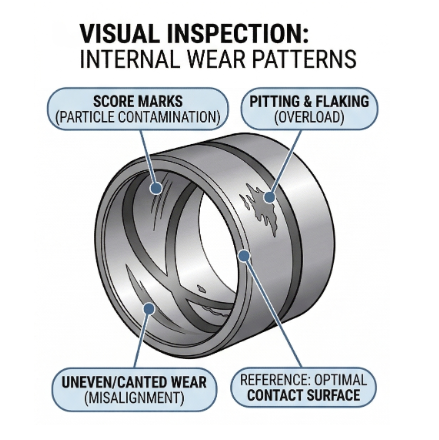
5. Visual Scoring and Pitting
Using the Diagram 3 (Material & Surface) we previously discussed, a healthy bushing should have a precision-ground, mirror-like finish.
- The Sign: Deep grooves (scoring) or small “craters” (pitting) on the internal diameter.
- The Cause: This is usually due to contamination—dirt or metal shavings getting trapped in the lubrication grooves and acting like sandpaper.
The Consequences: Why “One More Week” is a Bad Idea
Ignoring a worn bushing is a gamble that the bushing always loses. When you delay a replacement, you risk:
- Shaft Damage: Bushings are designed to be the “sacrificial” part. If the bushing wears through, the shaft starts grinding against the housing. Replacing a bushing costs $50; replacing a custom-machined shaft can cost $5,000.
- Increased Vibration: This leads to the failure of nearby seals, sensors, and bolts.
- Safety Hazards: In lifting or construction equipment, a snapped bushing can lead to a catastrophic loss of load control.
Need Help? > If your bushing is too damaged to measure, or you can’t find a match for your dimensions, call us at 860-693-1797 . We specialize in helping you find the right bushing, at the right price!